VoltzIQ Smart BMS
India's Most Advanced Battery Management System for Electric Vehicles
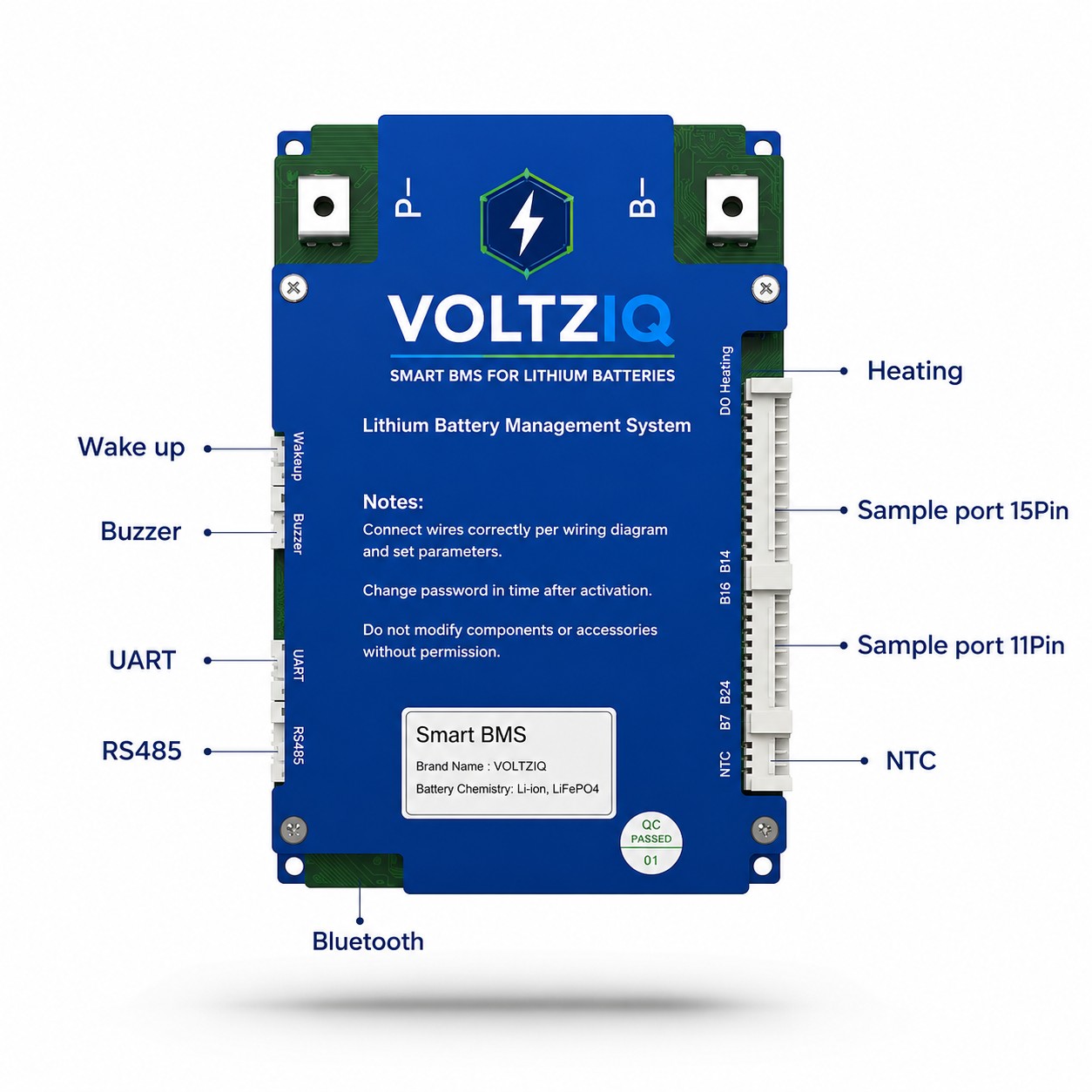
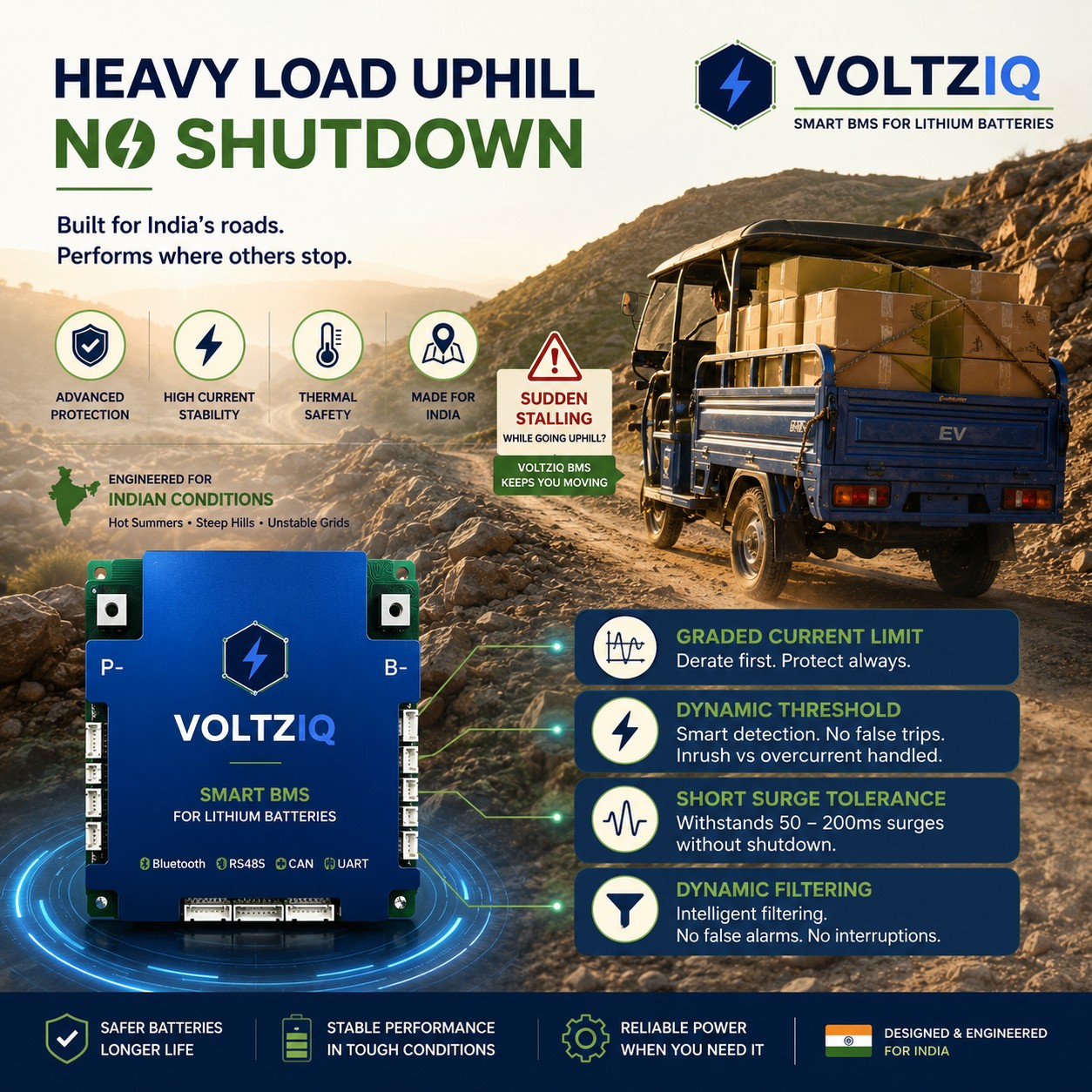
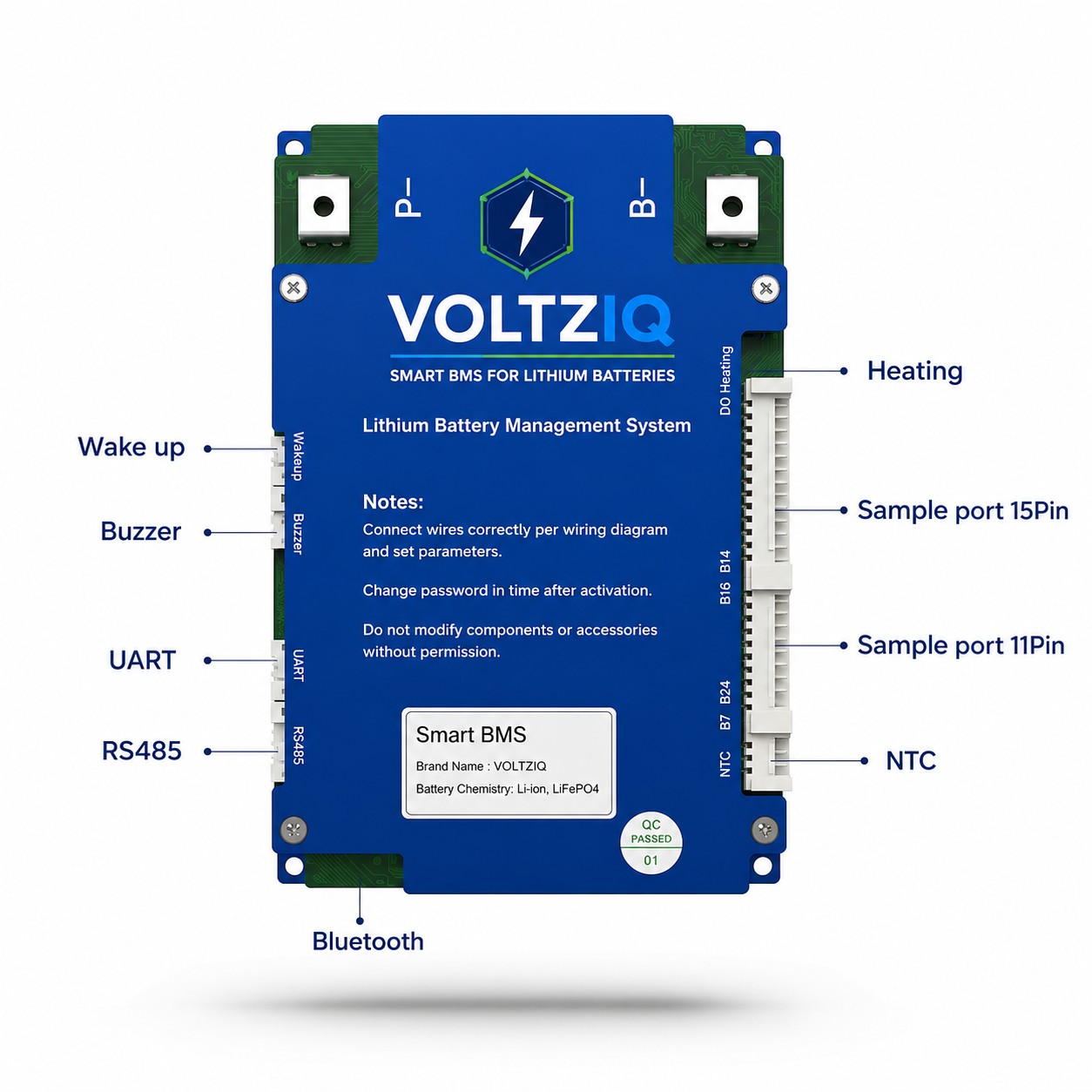
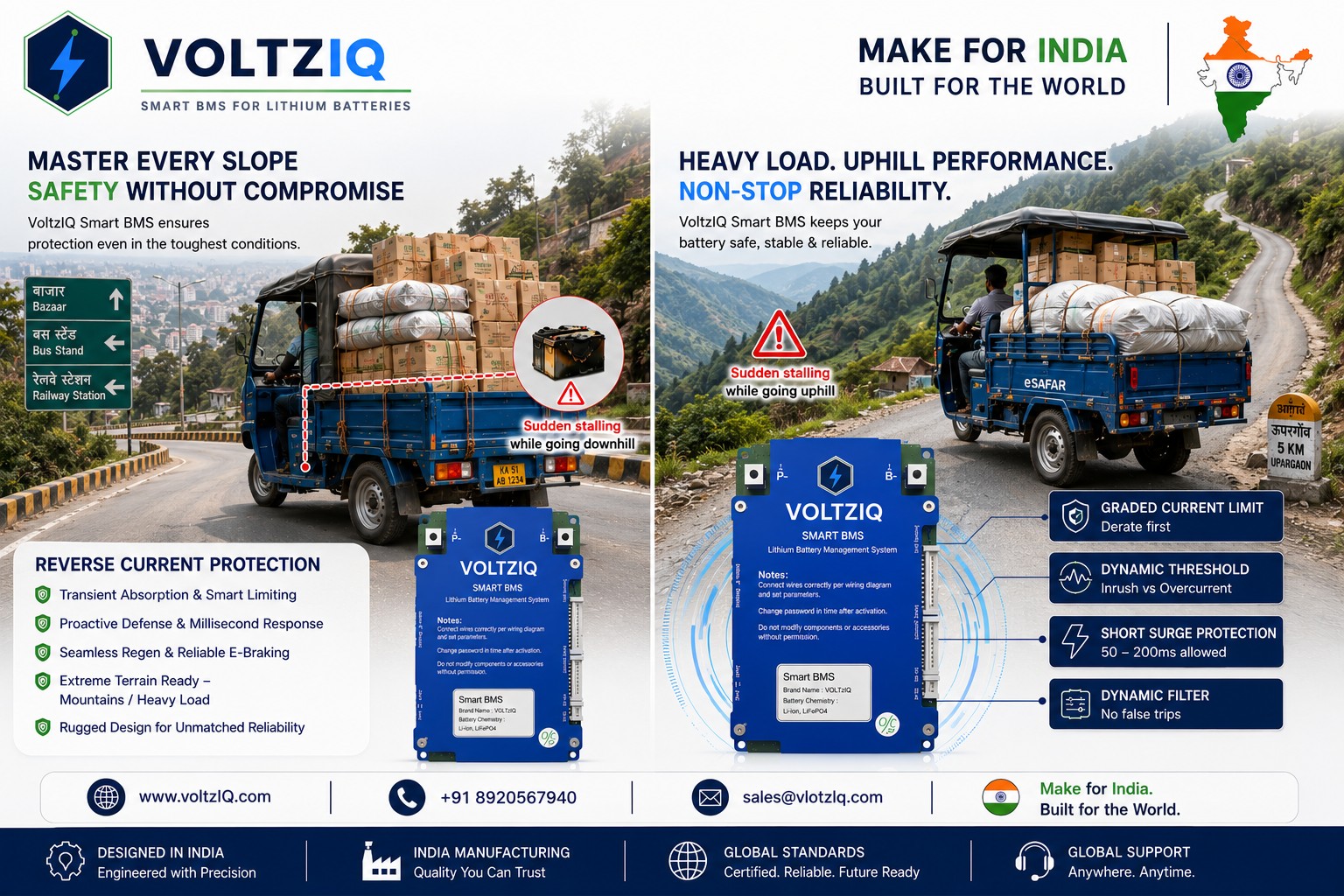
The VoltzIQ Smart BMS is India's most intelligent Battery Management System — purpose-engineered for high-temperature environments, unstable grid conditions, and the demanding load cycles of Indian electric two-wheelers, three-wheelers, and energy storage applications. Every protection layer is independently validated to operate without any communication dependency, ensuring true fail-safe operation throughout the battery's entire lifecycle.
Engineered to Run Cool Under India's Harshest Conditions
Conventional BMS units generate excessive heat during prolonged high-current operation — a critical failure point in India's 45°C+ summers. VoltzIQ's optimised PCB layout and precision power-stage design fundamentally change this equation.
At 60A continuous discharge, VoltzIQ records only a +31°C temperature rise — compared to the 57°C industry average. At 50A, this drops to just +17°C. That's a 40–45% improvement that directly extends component lifespan and battery operating range.
- +17°C rise at 50A continuous — lowest in class
- +31°C rise at 60A — vs 57°C industry standard
- Rated for full operation at 85°C ambient
- Precision heat-spreader PCB layout
Multi-Stage Surge Shield & Intelligent Heavy Load Guard
Lightning strikes, motor switching transients, and inverter noise generate destructive voltage spikes that silently destroy BMS motherboards and MOSFETs. VoltzIQ integrates a 3-tier TVS (Transient Voltage Suppression) array that clamps spikes before they reach any logic or switching components.
Heavy cargo, flyovers, and uphill starts require short bursts of 150–300% rated current. Our Intelligent Current Derating algorithm safely accommodates these transients — eliminating the nuisance shutdowns that stall livelihoods and destroy driver confidence.
- 3-stage TVS — absorbs spikes in under 1ns
- Steep-slope back-charge protection (exclusive)
- Surge current derating — no nuisance shutdowns
- Charger-connected surge management
AI-Powered Active Balancing — Charging, Discharging & Standby
Most BMS units balance cells only when plugged into a charger. VoltzIQ's Full-Time Intelligent Balancing algorithm operates across all three states — charging, discharging, and standby — using an inductive energy-transfer topology that consumes 10x less power than resistive passive balancers.
The result is genuinely equal cell voltages at all times, which directly translates to longer battery pack life, more accurate SOC readings, and increased usable capacity per cycle.
- Balancing in all 3 operating states
- 10x lower power consumption vs passive balancers
- Non-jumping, accurate SOC algorithm
- Cold-weather pre-heat function for winter starts
Battery Anti-Theft Lock & Comm-Independent Fail-Safe
Battery theft is a growing problem in fleet operations and swapping networks. VoltzIQ introduces a dual-layer anti-theft architecture: a secondary overvoltage alarm that triggers tamper alerts, combined with a firmware-level authenticated battery lock that prevents unauthorized discharge or extraction.
Critically, the core protection stack — overvoltage, undervoltage, overcurrent, short circuit — operates independently of CAN/RS485 communication. If your telematics link drops, your battery stays protected.
- Firmware-authenticated anti-theft lock
- Secondary overvoltage tamper alarm
- Comm-independent always-on core protection
- English + Hindi app — real-time BMS monitoring
Full Technical Parameters
Complete specification sheet for VoltzIQ Smart BMS — all variants. Contact us for model-specific datasheets.
| Parameter | Specification / Value |
|---|---|
| Nominal Voltage | 48V / 60V / 72V / 96V (customizable) |
| Cell Configurations | 13S / 16S / 20S / 24S / 30S (Li-ion, LFP) |
| Continuous Discharge Current | 60A / 80A / 100A / 150A / 200A / 500A |
| Peak Discharge Current | Up to 2× rated (short burst, auto-derate) |
| Charge Current | 20A – 80A (programmable) |
| Temperature Rise @ 60A | +31°C (industry: 57°C) — 45% better |
| Temperature Rise @ 50A | +17°C only |
| Operating Ambient Temperature | −20°C to +85°C |
| Cell Balancing Type | Full-Time Active (Inductive Energy Transfer) |
| Balancing Current | Up to 2A (per cell pair) |
| Balancing States | Charge + Discharge + Standby (all modes) |
| Surge / Spike Protection | Multi-Stage TVS Array (3-tier, <1ns clamp) |
| Regen Back-Charging | Steep-Slope Protection (exclusive) |
| Short Circuit Protection | Comm-independent, hardware-triggered |
| Overvoltage Protection | Primary + Secondary (alarm + lockout) |
| Communication Interfaces | CAN 2.0 / RS485 / Bluetooth 5.0 (BLE) |
| Anti-Theft | Firmware-level battery lock + alarm |
| Mobile App | Android / iOS — English + Hindi |
| OTA Firmware Update | Supported (BLE + 4G) |
| OEM Customization | CAN ID, SOC map, firmware, app branding |
| Rated Cycle Life | 4,000+ cycles |
| Enclosure / Protection | IP67-ready design (project specific) |
| Certifications | CE / RoHS / AIS-156 reference compliance |
| Dimensions | Customizable per application requirements |
| Cooling | Natural convection (no fan required) |
| Warranty | 12 months (OEM: negotiable) |
VoltzIQ vs. Conventional BMS
A direct engineering comparison across every critical protection tier.
| Capability | Conventional / Budget BMS | VoltzIQ Smart BMS |
|---|---|---|
| Thermal Performance (Rise @ 60A) | High — up to 57°C | Low — only +31°C |
| Heavy Load / Uphill Operation | Nuisance shutdowns | Smooth dynamic derating |
| Surge / Lightning Protection | Basic / Single-stage | 3-stage TVS array |
| Steep-Slope Regen Protection | Absent | Yes (exclusive) |
| Cell Balancing States | Charging only | Charge + Discharge + Standby |
| Balancing Power Consumption | High (resistive) | 10× lower (inductive) |
| Anti-Theft / Asset Security | Not available | Firmware lock + alarm |
| Communication Fail-Safe | CAN-dependent protection | Always-on, hardware-independent |
| India App (Hindi) | No | English + Hindi |
| OEM Customisation | Limited / Not available | Full (CAN, firmware, app) |
| Total Cost of Ownership | Higher warranty & failures | Lower lifetime cost |
Find the Right BMS for Your Pack
Select your cell configuration and peak continuous current. We'll recommend the VoltZIQ model that fits.
BMS Selection Tool
An engineering-matched recommendation, built on our standard LFP cell configurations and continuous current ratings.
| Cell Configuration | - |
| Nominal Voltage | - |
| Full Charge Voltage | - |
| Max Charge Voltage / Cell | - |
| Balancing Engine | - |
Datasheets & Engineering Documents
Download technical documentation for the Smart BMS family. Need a custom spec sheet? Request it through RFQ.
Smart BMS Datasheet
PDFFull specification sheet — voltages, current ratings, protection thresholds, communication interfaces, and mechanical drawings.
User & Integration Manual
PDFWiring, mounting, pre-charge circuit, first power-up, and troubleshooting for integrators and OEM technicians.
CAN & RS485 Protocol
PDFCAN 2.0B message IDs, frame formats, fault codes, and RS485 Modbus register map for vehicle and charger integration.
Test & Validation Report Guide
PDFHow we validate thermal, surge, EMC, and protection performance — and how you can request a test certificate.
Where VoltzIQ BMS is Deployed
Built and validated for India's most demanding EV segments.
E-Bikes
24V–48V pedal-assist and throttle e-bike packs with low-profile module BMS
E-Rickshaw & E-Bike BMSE-Scooters & E-2 Wheelers
48V–72V urban and semi-urban two-wheelers; daily commute and delivery use
Scooter BMSBattery Swap Networks
High-cycle swappable packs with anti-theft, health-scoring, and lease tracking
Swapping IoTLast-Mile Delivery Fleets
Fleet telematics 4G-ready packs with GPS, geofencing, and remote lock
Fleet IoTSolar & Energy Storage
Off-grid and hybrid storage packs with CAN bus integration for inverters
ESS BMSIndustrial EV & AGVs
96V–500A configurations for material handling, AGVs, and stationary UPS
UPS SystemsFrequently Asked Questions
Straight answers for engineers. If you don't find what you need, ask us directly.
A Battery Management System monitors every cell, controls charge and discharge, and protects the pack from overvoltage, undervoltage, overcurrent, temperature, and short-circuit events. A "smart" BMS adds telemetry, active balancing, OTA-updatable firmware, and communication with the vehicle and cloud. VoltZIQ's BMS is engineered specifically for Indian operating conditions — 45°C+ summers, unstable grids, hilly terrain, and heavy daily load cycles — with a protection stack that never depends on a live communication link.
VoltZIQ supports lithium-ion (NMC, NCA) and lithium iron phosphate (LFP) packs from 7S to 30S (24V to 120V+). Standard configurations include 13S (48V), 15S/16S/17S (48V/60V), 20S (72V), 24S/26S/28S (96V–100V), and 30S (120V+) for ESS and industrial applications. Custom configurations are available through an OEM RFQ.
Passive balancers burn off excess energy as heat and only work while charging. VoltZIQ's active balancer transfers energy between cells using an inductive topology, consuming up to 10x less power. It operates in all three states — charging, discharging, and standby — to keep cell voltages matched continuously. Balanced cells mean more usable capacity per cycle, longer pack life, and more accurate SOC readings.
BMS MOSFETs and power stages generate heat under continuous high current. In a 45°C Indian summer, a poorly designed BMS can push internal component temperatures past safe limits, accelerating degradation and causing de-rating. VoltZIQ's optimised PCB layout achieves a +31°C rise at 60A continuous and just +17°C at 50A, against a ~57°C industry average. Lower rise means sustained performance, longer component life, and no forced de-rating during peak-load climbs.
Lightning, inverter switching, and motor transients generate voltage spikes that can destroy logic and MOSFETs. VoltZIQ uses a 3-tier Transient Voltage Suppression (TVS) array that clamps spikes in under 1 nanosecond, shunting destructive energy before it reaches any sensitive component. This protects the BMS, the battery, and the entire vehicle electrical system.
On downhill stretches, regenerative braking can push current back into the pack at high rate. If the BMS treats this like a charger-fault and disconnects, drivers are left stranded — a real problem on ghat roads and flyovers. VoltZIQ's steep-slope back-charging logic safely absorbs regenerated energy within the pack's tolerance, without a nuisance disconnection or damaging the charging MOSFETs.
Yes. Overvoltage, undervoltage, overcurrent, and short-circuit protection are implemented in hardware and run completely independently of CAN, RS485, or Bluetooth links. If telematics drops, connection is lost with the charger, or a bus is disrupted, the pack stays protected — true fail-safe behaviour.
CAN 2.0B for vehicle and charger integration, RS485 (Modbus RTU) for ESS and industrial stacks, and Bluetooth 5.0 BLE for the mobile app. Optional 4G telematics hardware adds GPS, cloud streaming, remote lock, and OTA firmware updates.
Yes. OEM customization covers CAN message IDs and frame formats, SOC/SOH behaviour mapping, protection thresholds, firmware parameters, mobile app branding, connector pin-outs, and mechanical form factor. Customizations are scoped through an RFQ so that both engineering and commercial terms are agreed before sampling.
A firmware-level authenticated lock prevents the pack from powering an unrecognised vehicle. Combined with a secondary overvoltage tamper alarm and optional 4G telemetry, the system can raise an alert and even enable remote immobilization if theft is detected. This is especially valuable for battery swapping networks and leased fleets.
Balancing current is up to 2A per cell pair, with a balancing resolution of approximately 3 mV. The algorithm operates on the difference between cell voltages and continues to level the pack in all three operating states.
Continuous discharge ratings span 30A through 500A depending on model (60A/80A/100A/150A/200A/300A/500A standard). Peak current up to roughly 2× rated is allowed for short bursts (uphill starts, cargo launch) through intelligent current derating, which safely accommodates transients instead of nuisance-shutting down.
VoltZIQ uses a hybrid Coulomb-counting + voltage/OCV-correction algorithm with drift compensation, giving a non-jumping SOC display. Cold-weather pre-heat logic also improves winter-time accuracy and start reliability.
Yes. Firmware can be updated over Bluetooth (BLE) from the mobile app and over the air through the 4G IoT module. This lets you tune balancing parameters, safety thresholds, and communication behaviour across deployed packs without a teardown — ideal for field quality programs.
Operating ambient range is −20°C to +85°C with full protection functionality. Natural convection cooling, so no fan is required. Pack-level thermal management (where required) is designed together with your pack integrator.
VoltZIQ BMS is designed for CE and RoHS compliance, with protection and communication architecture aligned to AIS-156 for EV battery safety. Certification copies and test summaries are provided against an NDA and can be discussed through the /certifications page.
Yes. The BMS streams cell voltages, pack temperature, current, SOC, and alerts over CAN to an optional 4G telematics module. The VoltZIQ cloud platform provides live GPS tracking, geofencing, remote lock, fleet analytics, and a REST API plus webhooks for integration with your own systems. See the IoT Platform page for details.
The MOSFETs are opened by a hardware-triggered protection path within microseconds — independently of firmware and communication. The fault is latched and requires a cleared condition to recover, preventing toggling, arc damage, and cable or connector meltdown.
Standard warranty is 12 months against manufacturing defects in normal operating conditions. OEM-level warranty terms (duration, field-return process, and exchange) are negotiated as part of the OEM RFQ agreement.
Submit an RFQ from this page or /rfq with your cell configuration, voltage, current rating, and annual volume. Our engineering team responds within 24 business hours with the datasheet, recommended model, sample lead time, and pricing for your volume tier.
Standard engineering samples typically ship within 1–3 weeks depending on configuration and documentation (CAN protocol, drawings, test report). Production lead times depend on volume and are confirmed with the commercial quotation.
Ready to Upgrade Your Battery System?
Request an engineering-reviewed quote and get the Smart BMS datasheet within 24 business hours.
1405A & 1405B, Iconic Corenthum Tower C,
Sector 62, Noida 201301